India's foreign policy establishment is adjusting with alacrity in real time -- an extraordinary spectacle in itself, considering the manifest reluctance to indulge in public diplomacy critical of American moves, observes Ambassador M K Bhadrakumar.

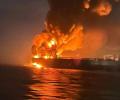
The Congress on Sunday lashed out at Prime Minister Narendra Modi over the US' statements after three Indian sailors were killed in American attacks on ships, with party leader Rahul Gandhi saying the "compromised PM" listens "like an obedient servant" and "complies with the orders".

Defence Minister Rajnath Singh assures India's energy security amidst West Asia tensions, highlighting naval protection of tankers and readiness to counter cross-border terrorism.

Chinese President Xi Jinping has called for the Strait of Hormuz to remain open for normal passage of ships, describing it as an 'international waterway' amid rising tensions between the US and Iran.

One Indian oil tanker successfully crossed the Strait of Hormuz, while others turned back after Iran signalled the waterway's closure, amidst rising tensions and disruptions to global energy flows.

Conflicting reports emerge regarding the effectiveness of the US blockade on Iranian ports, with Iran claiming successful transit of vessels and the US asserting complete maritime dominance.

US Secretary of State Marco Rubio stated that significant progress has been made in negotiations with Iran to reopen the Strait of Hormuz, a critical global shipping lane. However, President Donald Trump remains cautious, vowing not to accept a 'bad deal' regarding Iran's nuclear programme and regional stability.

India has denied making any payments to Iran to secure safe passage for its vessels through the Strait of Hormuz, following reports that Indian vessels were fired upon in the region.

Iran has reportedly allowed select "friendly nations" including India and Pakistan limited access to the Strait of Hormuz amid ongoing conflict, easing some energy supply concerns. Here's what the move means for global trade and oil routes.

The US military is considering a new wave of military operations in Iran, including potential strikes on infrastructure and securing Iran's stockpile of enriched uranium, amid a fragile ceasefire and stalled nuclear talks.

US Vice President J D Vance is expected to travel to Islamabad for peace talks with Iran to end the seven-week war, amid a fragile ceasefire and ongoing tensions.

Iran's ambassador to India, Mohammad Fathali, has described India as a "reliable and compassionate" partner while asserting Tehran's territorial authority over the Strait of Hormuz amidst ongoing regional tensions.

Iran has submitted a fresh proposal to regional intermediaries offering to cease its military operations in the Strait of Hormuz, contingent upon a complete cessation of hostilities and the removal of the US blockade on Iranian maritime hubs.

In a development that could reshape West Asia's security landscape, US President Donald Trump announced Friday that he will convene an emergency meeting in the White House Situation Room to make a final decision on a broad, multi-part peace deal with Iran.

The United States Central Command (CENTCOM) has confirmed the implementation of a naval blockade on Iranian ports, enforcing strict measures on vessels entering or departing, significantly escalating tensions between the two nations.

US President Donald Trump has indefinitely extended the ceasefire with Iran at the request of Pakistan, aiming to allow Tehran's leadership time to form a unified proposal to end the seven-week war.

Occasionally, the silence of the night shift would be shattered by an ear-splitting alarm: 'ALERT, ALERT... This is a security warning.' We were drilled to move away from the windows and avoid the lifts, recalls Krishna Kumar NP, a veteran Dubai-based journalist.

Modi's comments on underlining the importance of ensuring the safety of seafarers came against the backdrop of growing anger in India over the killing of the three Indian crew members in a US military attack on a merchant ship off the coast of Oman last week.

Iran has submitted its latest proposal aimed at advancing negotiations to end the ongoing West Asia conflict with the US, days after the Islamic Republic submitted a fresh proposal through regional intermediaries to cease its military operations in the Strait of Hormuz, which is likely to get rejected by Washington.

Indian benchmark indices Sensex and Nifty experienced volatility due to conflicting developments in West Asia, including reports of the Strait of Hormuz closure, which led to a rebound in crude oil prices and heightened investor concerns about supply disruptions and inflation.
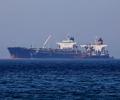
The US has sanctioned an Indian national based in the United Arab Emirates and two India-based entities for operating as part of Iran's shadow fleet and involved in shipping Iranian oil. The US Department of the Treasury said Jugwinder Singh Brar, who owns multiple shipping companies, operates as part of Iran's shadow fleet, which the US said is used to evade sanctions and transport Iranian oil. Brar also owns or controls India-based shipping company Global Tankers Private Limited and petrochemical sales company B and P Solutions Private Limited. The sanctions come as part of a US campaign of maximum pressure on Iran and target the country's petroleum and petrochemical sectors.

Two India-bound LPG tankers have crossed the Strait of Hormuz amid heightened tensions in the region, while an India-flagged vessel sank after being hit near the strategic shipping corridor.

Iran has strongly criticised US plans to impose a blockade on its ports, warning that maritime security across the Persian Gulf region would be jeopardised if its own security is threatened.

The naval command underlined recent regional developments, which have now established a new reality in which extra-regional powers, led by Washington, DC, can no longer dictate terms or project unchecked influence in Iran's immediate maritime environment.

The Ministry of External Affairs (MEA) has refuted reports suggesting a deal with Iran involving the release of seized vessels in exchange for safe passage of Indian ships through the Strait of Hormuz.

Indian refiners have access to only limited Iranian volumes compared with Russian oil, and even the barrels on offer come with 'too many hassles'.

This sharp Iranian response came after a series of uncompromising remarks from the US president.

The United States and Iran could resume negotiations as early as next week in Islamabad, according to a report by The Wall Street Journal citing people familiar with the matter.

Iran has announced the reinstatement of strict military control over the Strait of Hormuz, citing US violations of previous agreements regarding maritime passage. This decision follows claims of continued American blockade of Iranian ports and a statement from former US President Trump regarding the persistence of the naval blockade until a comprehensive peace agreement is reached.

The Indian government has refuted reports suggesting a deal with Iran involving the release of seized oil tankers in exchange for safe passage of Indian vessels through the Strait of Hormuz.

According to an official Iranian military statement, Qader anti-ship cruise missiles were launched at the carrier, forcing it to alter its position in the region.

The US Central Command (CENTCOM) announced the start of operations to clear mines in the Strait of Hormuz, a claim swiftly denied by Iran, leading to increased tensions in the region amidst stalled negotiations between the two countries.

Trump criticised Iran for attempting to use international waterways for leverage, stating that the United States had restrained itself only to allow space for negotiations.

Sri Lanka's President Anura Kumara Dissanayake announced that the country refused permission for the US to land two warplanes at Mattala International Airport, citing a commitment to neutrality amidst rising tensions in the Middle East.

US President Donald Trump in an exclusive interview to Axios on Wednesday, said that he would continue to keep the naval blockade until Iran agrees to deal with the United States by addressing America's concerns about the nuclear programme.

In a post on Truth Social, Trump said the decision followed a request from the Iranian government and added that talks between the two sides were 'going very well'.

India has raised concerns with Iran over the safety of merchant shipping after two vessels were fired upon in the Strait of Hormuz, prompting them to turn back.

There are enough people at the top decision-making level in Tehran who are still willing to negotiate, provided Trump can create the right setting for the negotiation to acquire a dynamic of its own, points out Ambassador M K Bhadrakumar.
US Vice President JD Vance is set to arrive in Islamabad on Monday evening to lead a high-level American delegation in a second round of ceasefire negotiations with Iran, CNN reported, citing White House on Sunday.

Trump's message, posted on his Truth Social platform, is a reminder of his 10-day ultimatum given to the Islamic Republic earlier to make progress toward a deal or reopen the vital shipping lane.
